
Mießlgasse 43 (laid 2010, renewed 2015)
Helga Pauer
In the clutches of Dr. Gross
Helga Pauer, born 7 July 1939 in Graz; the family later moved to Wiener Neustadt. Admitted to the children’s ward “Am Spiegelgrund” on 17 June 1941; the child died on 18 August 1941.
The Pauer family came from Graz, where Helga was born. Her home birth was complicated, resulting in severe brain damage. Engineer Rudolf Pauer found work at the aircraft factories, and the family moved to the WNF housing in Mießlgasse. The mother lovingly cared for the disabled child, “who usually put on an enchanting smile when she recognized her mother.”
A decree dated 18 August 1939 required all midwives and pediatricians to report disabled children to the Reich Committee in Berlin.
At one and a half years old, Helga began suffering seizures, and her parents consulted a pediatrician. On 7 December 1940, the doctor dutifully sent a report to Berlin. The diagnosis declared the child incapable of any development.
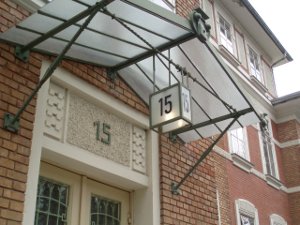
Meanwhile, the “Am Steinhof” clinic had established a children’s ward — the second largest in the German Reich. Two pavilions were used, including Pavilion 15, the “killing pavilion,” where nearly 800 children were murdered by the end of the war. The children were sedated with medication until they slipped into a deepening twilight state from which they never awoke.
In June 1941, Helga was taken from her home by order of the health office. The parents were kept in the dark about everything that followed.
At Spiegelgrund, Pavilion 15, Dr. Gross conducted the admission examination. The diagnosis was essentially a death sentence.
On 16 August 1941, Dr. Gross wrote to Helga’s father: “The institution regrets to inform you that your child … Helga has contracted severe toxic diphtheria and that death must be expected.” Helga Pauer died on 18 August 1941.
The next day, the Pauer family received a telegram with the death notice. At that time, Helga’s mother was six months pregnant with her next child.
When asked for permission to lay a Stolperstein for Helga Pauer, her sister wrote: “Yes, I agree — and I thank you for making it your mission to remember the euthanasia victims of National Socialism at Spiegelgrund.”
After receiving photos of the Stolperstein installation, she wrote: “Now, after almost 70 years, Helga — as I see it — has finally found peace!”
Anton Blaha