
Flugfeldgürtel 13/15 (laid 2011)
Eduard Schaller
Spanish Civil War fighter
Eduard Schaller, born 9 January 1919 in Wiener Neustadt, unmarried.
Fought in the Spanish Civil War. After the defeat, arrested by the French at the border and handed over to the SS. Transferred to Dachau and died in April 1944 in the Friedrichshafen subcamp.
From 1936 to 1939, the democratically elected Spanish government fought against General Franco’s putschists. The fascist side was supported primarily by the Axis powers Germany and Italy, while the Republicans were reinforced by the International Brigades (French, Germans, Italians, Yugoslavs, and many Austrians). At that time, it was possible to inform the clandestine “Red Aid” that one was willing to volunteer for Spain and fight against fascism. The conflict ended with Franco’s victory and a dictatorship that lasted until his death in 1975.
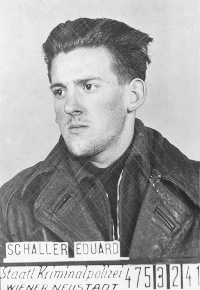
(© StAWN, IVM photo collection)
Professor Karl Flanner recalls: “Several men from Wiener Neustadt went to Spain, including my best friend, Schaller Ederl. Like him, I volunteered as well. It was very bitter for me that my offer was not accepted because I was only sixteen and a half (the minimum age was eighteen). Ederl and some of his friends set off on a sunny day in 1937. We said goodbye at the Kronen Pharmacy on the main square. The farewell hurt both of us — we did not know whether we would ever see each other again. A final handshake, a friendly pat on the shoulder of his friend, and then: ‘Servus, Ederl! Take care in Spain, take care!’ And he hurried off in long strides after the other two.
After the defeat in Spain, Ederl was arrested by the French authorities while crossing the border and later handed over to the SS. They deported him to the Dachau concentration camp. I too had been deported there by the SS. But when I arrived, he had already been transferred to the so‑called subcamp in Friedrichshafen. My hope of seeing him again there was in vain. I was assigned to work in Block (barracks) 14 as an assistant clerk and had to maintain the extensive prisoner register. Three categories had to be managed: the sick and unfit for work, the working prisoners, and the deceased. On the index cards of the latter, I had to draw a cross. One day in April 1944, devastating news reached me: I was instructed to remove Ederl’s card and mark it with a cross. He had fallen victim to a bomb during an American air raid. In my memory, he lives on — a fearless and comradely figure.”
Anton Blaha, based on Resistance in the Wiener Neustadt Region 1938–1945 by Karl Flanner