
Kaisersteingasse 13 (laid 2011)
Johann Hödl
A victim of an act of revenge?
Johann Hödl, born on 11 October 1888 in Gloggnitz, station master.
Arrested on the night before the “Anschluss” and on 1 April 1938 taken to Dachau in the so-called “Prominent Transport” and then to Mauthausen concentration camp. He died there on 27 March 1940.
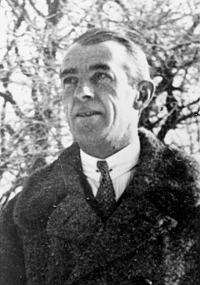
(© StAWN, photo collection IVM)
Johann Hödl was the city leader of the Heimwehr in Wiener Neustadt. During the suppression of the Nazi coup attempt on 25 July 1934, he was involved in supervising the Nazis who were imprisoned in Wiener Neustadt and held in Wiener Straße 12.
In the night of 11 to 12 March 1938, the night before the “Anschluss” to Hitler’s Germany, the station master in Gutenstein, who had long served as station dispatcher in Wiener Neustadt, was taken from his bed by a group of Nazis led by an illegal SA man, and a pistol was held to his neck. They drove him to Wiener Neustadt in a car. His wife managed to see him the next day in the police prison in the town hall building — for the last time. He was taken to Vienna and from there, with the first transport of Austrian prisoners, the so-called Prominent Transport, to Dachau. When Mauthausen concentration camp was established shortly thereafter, Johann Hödl was transferred there.
Hödl suffered from stomach problems and his health was therefore already weakened. When he became seriously ill — probably with dysentery — he reported to the camp infirmary in a very weakened state. From there he wrote a letter to his wife: “… If anything should happen to Hans in the war, then arrange for a family grave in Wampersdorf and have him transferred there …” But there was no Hans in the family, apart from himself, and he had always liked staying in Wampersdorf. His wife then became suspicious that something bad might be happening to him. The next letter was heavily censored. Apparently Johann Hödl had communicated something important that he knew he would never be able to say again. In fact, it was his last letter. Shortly afterwards, the camp sent word that he had “died of a stroke” on 27 March 1940.
Anton Blaha, based on Widerstand im Gebiet Wiener Neustadt 1938 bis 1945 by Karl Flanner.