
Wiener Straße 95 (laid 2011, renewed 2015)
Max Stössel
Freed twice
Max Stössel, born on 16 May 1902 in Wiener Neustadt, married, civil servant.
Wife Luise, born on 17 June 1904.
Son Julius, born on 28 December 1923.
He was first imprisoned in Dachau on 25 June 1938 and then transferred to Buchenwald, where he was released on the condition that he emigrate. He fled to Italy and France. He was interned in Drancy, deported to Auschwitz in 1942, and died there in 1944. Julius was also sent to Drancy and Auschwitz in 1944 but survived.
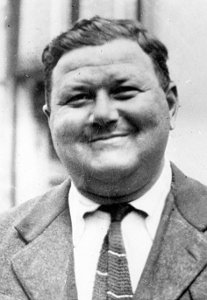
(© StAWN, photo collection IVM)
Through arbitrary measures, Jewish residents were harassed and persecuted from the very beginning of Nazi rule, with the aim of forcing them to emigrate. Those who did not leave — perhaps because of their families — risked their lives.
Max Stössel was arrested at the time and deported to Dachau and later Buchenwald. He had the chance to be released, but had to prove that he was about to emigrate. His wife then tried to find a travel agency that would make a fake booking at great expense. His passport and travel documents had to be sent to Buchenwald. They were checked there, and Max Stössel was in fact released a year later in order to emigrate. But he had to report regularly to the police, and since he did not leave, he was one day held in a police detention center and his wife was told that he would be sent back to Dachau if he did not leave within a few days.
Once again, she ran to various travel agencies until she managed to obtain emigration papers for Shanghai. And once again Max Stössel was set free. This time he went straight to Milan, where his son followed him and his wife was supposed to join them, but the outbreak of war and the closing of borders prevented this.
Max Stössel and his son then crossed the border into France by clandestine routes, where they were first interned in the camps of Gurs and Drancy and then moved to Lyon. There Max Stössel was arrested by German police — France had by then been occupied by the Wehrmacht — and on 4 November 1942 taken to Auschwitz concentration camp. The SS, from whose clutches he had twice escaped, gave him no further chance of survival, and he died on 9 January 1943.
Julius, Max Stössel’s son, was able to remain in France for some time but was also deported to Auschwitz in 1944. He could no longer find his father there. Shortly before the liberation of Auschwitz by the Red Army, Julius was deported with a large prisoner transport to Buchenwald and regained his freedom there during the prisoners’ liberation action on 11 April 1945.
Anton Blaha, based on Widerstand im Gebiet Wiener Neustadt 1938 bis 1945 by Karl Flanner.